
Audience Growth: How To Build An Engaged Audience For Affiliate Marketing
Search traffic brings people to your site once, but audience growth is what brings them back without you needing to rank for the same keyword twice. Getting visitors to your website is useful, but building an audience that returns, subscribes, reads your content, and trusts your recommendations creates far greater long-term value.
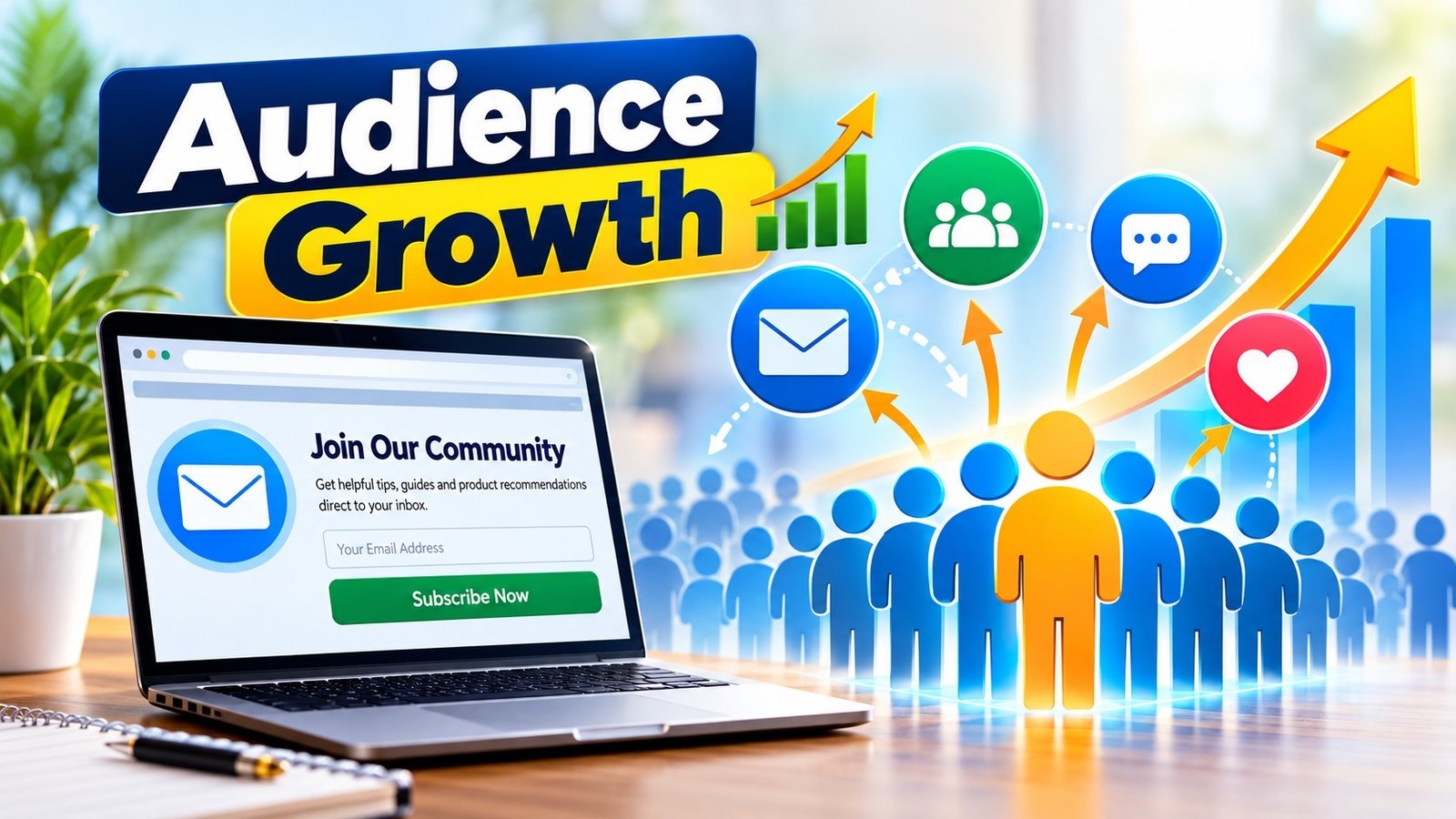
An email list, a returning reader base, and an engaged community turn a site that depends entirely on search algorithms into a business with its own direct line to its visitors. We will now look at the practical side of audience growth: building a list even with modest traffic, keeping subscribers engaged instead of unsubscribing, turning one-time visitors into people who come back on their own, and tying all of it together into a single working funnel.
Why Audience Growth Matters Beyond Search Traffic
Search rankings can change overnight due to an algorithm update, a new competitor, or a shift in demand, and a site that depends entirely on search traffic has no cushion when that happens. An email list and a base of repeat readers are channels you own outright; no algorithm change can take them away. They also tend to convert better than first-time search visitors, since a subscriber who opted in has already shown a level of trust that a cold visitor hasn’t. Audience growth, in other words, involves more than increasing traffic. It includes attracting the right people, giving them a reason to subscribe, communicating with them consistently, and providing value over time.
What an Audience Growth Strategy Can Include
- Creating useful, SEO-focused content
- Building an email subscriber list
- Offering genuinely useful lead magnets
- Publishing helpful, consistent newsletters
- Encouraging visitors to return to the website
- Building a community around a specific topic
- Sharing content on appropriate social platforms
Email List Building Basics
Email list building basics start with giving visitors a clear, low-friction reason to hand over their email address. A list grows fastest when the opt-in offer is specific and obviously useful, not a vague “subscribe to our newsletter” button buried in the footer. Search rankings and social reach can change, but an email list gives you a direct communication channel with people who have voluntarily subscribed.
- Place opt-in forms where attention is naturally high, such as the end of a popular article or within the content itself
- Offer something specific and immediately useful in exchange for an email address
- Match the lead magnet to the article’s topic rather than using one generic offer sitewide
- Keep the sign-up form short, asking only for an email address unless more information is genuinely necessary
- Use an email service provider that supports automation, segmentation, and basic analytics from the start
- Be transparent about what subscribers will receive and how often
Getting Subscribers With Low Traffic
Getting subscribers with low traffic feels discouraging when the numbers are small, but a new site doesn’t need huge visitor counts to start building a list worth having. A website receiving a small number of highly targeted visitors can often generate subscribers more effectively than a larger site pulling in unrelated traffic.
- Focus opt-in offers on your highest-traffic pages first, rather than spreading effort evenly across a thin site
- Use exit-intent or scroll-based popups sparingly on your best-performing content
- Promote your lead magnet directly on social media and in relevant online communities, not just on your site
- Prioritize list quality over raw size in the early stages; a smaller, genuinely interested list converts better than a large, disengaged one
- Be patient and consistent, since list growth compounds slowly before it compounds quickly
Lead Magnet Ideas for Affiliates
Good lead magnet ideas for affiliates solve a small, specific problem related to the content someone is already reading, rather than offering something generic that could apply to any website. A lead magnet doesn’t need to be complicated; a practical checklist, buying guide, or short resource is often enough.
- A downloadable checklist that summarizes a buying guide’s key decision points
- A comparison chart or worksheet covering products discussed across multiple articles
- A short email course walking a beginner through a decision in your niche step by step
- A curated resource directory or list of recommended products at different price points
- A free template or planning guide relevant to your niche
- A discount or early-access notification list for a specific product category you cover
The strongest lead magnet is usually the one that solves a specific problem for the visitor, connected directly to the page where they discover it, rather than a generic download offered sitewide.
Welcome Email Sequence Outline
A strong welcome email sequence outline sets the tone for the entire subscriber relationship, since open rates on welcome emails are typically far higher than on any later newsletter. The purpose is to establish expectations and provide value, not to immediately send aggressive promotional messages.
- Email 1: Deliver the promised lead magnet immediately and set expectations for what’s coming next
- Email 2: Introduce your site and explain the kind of information subscribers can expect
- Email 3: Share your most valuable or most popular piece of content to build early trust
- Email 4: Address a common problem within your niche with genuinely useful guidance
- Email 5: Recommend a specific product or comparison relevant to what brought them to the list
- Email 6: Invite a reply or a specific action, such as exploring more content or following on social media
Newsletter Content for Affiliates
Deciding on newsletter content for affiliates is where many lists stall, since repeatedly promoting products without providing value quickly trains subscribers to stop opening emails. A newsletter doesn’t need to promote a product in every edition; it needs to give subscribers a clear reason to open the next one.
- Share new articles alongside a short personal take on why they’re worth reading
- Highlight a specific product update, price drop, or seasonal deal relevant to your niche
- Answer a reader question or address a common misconception you’ve noticed
- Round up several related articles into a themed digest rather than sending every post individually
- Share useful industry resources, beginner tips, or educational information alongside product mentions
- Keep the ratio weighted toward genuinely useful content, with recommendations woven in naturally rather than dominating every email
Reducing Email Unsubscribes
Reducing email unsubscribes comes down to consistently matching what subscribers were promised when they signed up. A spike in unsubscribes is almost always a signal worth investigating rather than ignoring.
- Send at a consistent, predictable frequency rather than erratic bursts
- Avoid sending an email that is purely a sales pitch with no informational value
- Segment your list where possible, so subscribers only receive content relevant to their original interest
- Use clear subject lines and make emails easy to read on mobile devices
- Review unsubscribe rates after each send to spot patterns tied to specific content types
- Make unsubscribing easy and respectful, since a frustrating opt-out process damages brand trust more than the unsubscribe itself
Turning Visitors Into Repeat Readers
Turning visitors into repeat readers doesn’t require every visitor to subscribe to an email list immediately. Several lower-commitment touchpoints can bring someone back before they’re ready for that step, gradually turning a collection of individual pages into a resource people return to on their own.
- Link to related articles within the content itself, not just in a sidebar widget
- Encourage bookmarking or following on a platform the reader already uses daily
- Build genuinely useful resource pages, such as buying guides, that readers return to repeatedly over time
- Keep a consistent publishing schedule so returning visitors know new content is worth checking for
- Use clear calls to action that point to a logical next step rather than a dead end
- Use browser push notifications sparingly, if your audience responds well to them, as a lighter-touch alternative to email
Community Building for Beginners
Community building for beginners doesn’t require a large, complex platform from day one. A small, genuinely active group is worth far more than a large, silent one, and the objective is to make readers feel your site provides ongoing value rather than being simply a collection of affiliate links.
- Start with a lightweight option, such as a comment section, a social media group, or a simple forum thread
- Participate actively yourself, since a community rarely grows if the founder doesn’t show up consistently
- Ask specific questions that invite discussion rather than generic prompts nobody responds to
- Invite subscribers to reply to selected emails, and respond to the comments and questions you receive
- Highlight community members’ questions or contributions in your content when relevant
- Grow the format over time, only upgrading to a dedicated platform once genuine demand justifies it
Social Sharing Without Spamming
Social sharing without spamming means promoting your content consistently without turning your presence into a wall of repetitive self-promotion that people tune out or unfollow. Social platforms should complement your broader audience growth strategy rather than becoming the only source of visitors.
- Share genuinely useful insights from your content, not just a link and a generic caption
- Adapt your message and format to each platform’s norms, since what works on one channel can feel spammy on another
- Participate in relevant conversations and communities beyond simply posting your own links
- Vary the format of what you share, mixing questions, tips, and behind-the-scenes content with direct links
- Space out promotional posts rather than posting the same link repeatedly across a short period
A Simple Audience Growth Funnel
Audience growth becomes far more effective once your content, email marketing, and social presence work together as one connected system rather than separate, disconnected efforts.
- Search or social: a potential reader discovers your content
- Useful article: the visitor finds a genuine answer to their problem
- Lead magnet: the visitor receives a specific, compelling reason to subscribe
- Welcome sequence: the new subscriber receives helpful, trust-building information
- Newsletter: the subscriber receives ongoing value between visits
- Repeat visit: the reader returns to the website on their own
- Affiliate recommendation: relevant products are introduced when it genuinely fits
Measuring Audience Growth
You can improve your strategy by monitoring meaningful audience metrics rather than focusing only on total website traffic.
- New email subscribers over time
- Email open and click activity
- Unsubscribe rates after each send
- Returning website visitors as a share of total traffic
- Lead magnet conversion rates
- Engagement with newsletter content specifically
- Traffic and engagement from social platforms
- Affiliate clicks and conversions coming from subscribers versus cold visitors
Reviewing these measurements regularly helps identify which content attracts visitors, which resources actually generate subscribers, and which communication methods keep people engaged over time.
Frequently Asked Questions
How can I grow an affiliate audience with little traffic?
Start by targeting relevant visitors rather than focusing only on traffic volume. Use useful content, a closely matched lead magnet, a simple subscription form, and helpful email communication to convert the right visitors into subscribers.
How many subscribers do I need before an email list becomes worthwhile?
There’s no fixed number. Even a small, engaged list can generate meaningful affiliate revenue, since subscribers typically convert at a higher rate than first-time search visitors. Focus on engagement quality rather than waiting for a specific subscriber count.
What makes a good affiliate lead magnet?
A good lead magnet solves a specific, immediate problem related to content the visitor is already reading. Checklists, templates, buying guides, tutorials, and comparison worksheets tend to outperform generic offers like a plain newsletter sign-up.
How often should an affiliate newsletter be sent?
Consistency matters more than frequency. A predictable weekly or biweekly schedule that subscribers can rely on generally performs better than sporadic, unpredictable sends.
How do I reduce email unsubscribes?
Keep emails relevant to the reason people subscribed, avoid excessive promotion, and communicate on a consistent schedule. A noticeable spike in unsubscribes after a specific email usually points to a mismatch between that email’s content and what subscribers expected.
Do I need a large following to build a community around my site?
No. A small, active group of genuinely engaged readers is more valuable than a large, inactive one, and most successful communities start informally, such as through comments or a social group, before growing into a dedicated platform.
Click Here For Our Affiliate Disclosure
