
Search Traffic: A Complete Guide To Getting Found And Getting Ranked
No matter how good your content is, it earns nothing if nobody finds it. Search traffic is the engine behind most profitable affiliate sites, and it depends on a chain of things going right: your site needs to be indexed, your keywords need to match what people actually search for, your pages need to satisfy real search intent, your content needs to be genuinely useful rather than duplicated, and your internal structure needs to help both readers and search engines understand how everything connects.
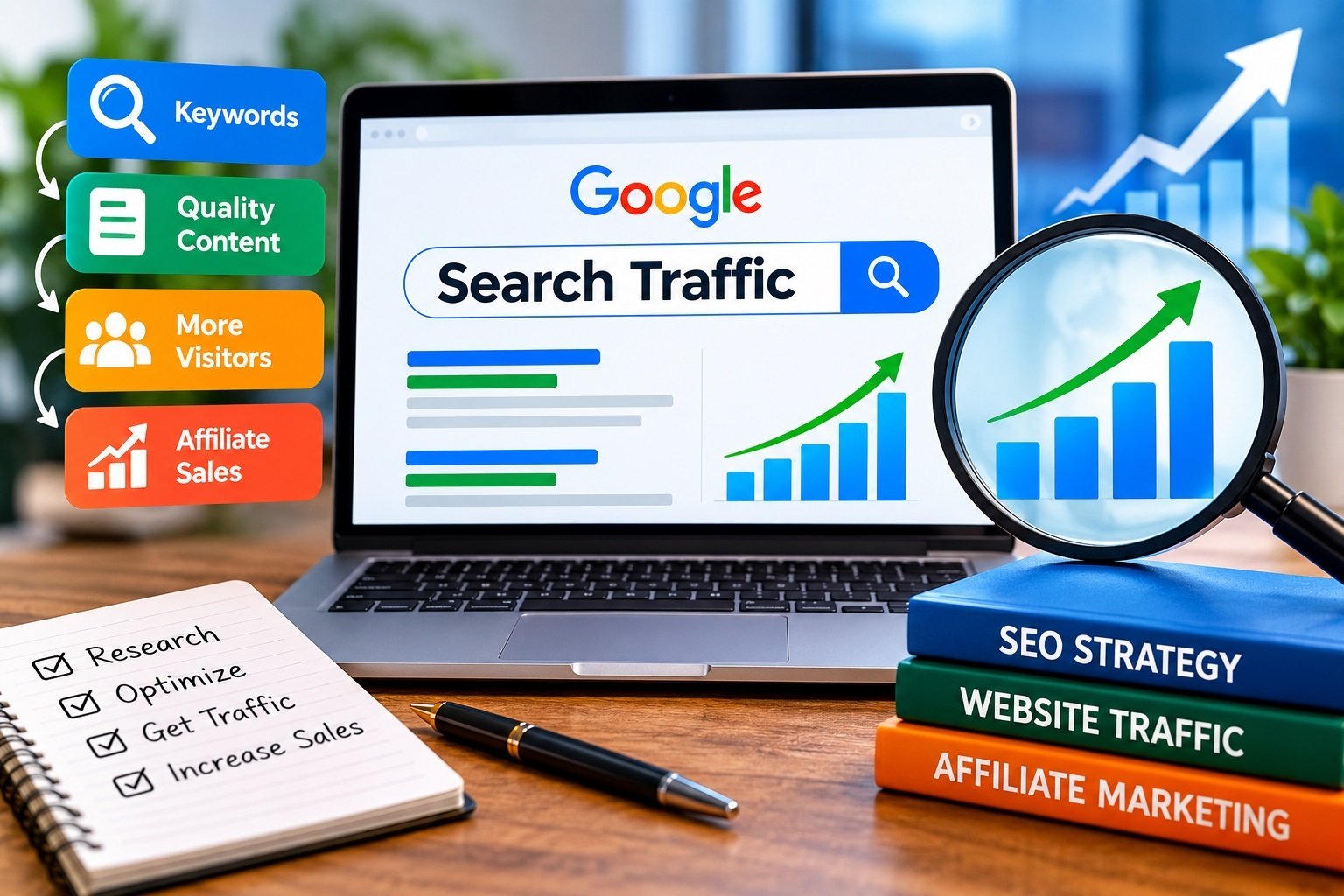
Unlike traffic generated entirely through paid advertising, organic search visibility keeps sending visitors long after an article is published. This guide walks through the whole chain, from getting a brand-new site indexed to diagnosing why an individual review page refuses to rank.
Why Search Traffic Matters So Much for Affiliate Sites
Affiliate income is fundamentally a volume game built on trust, and organic search is one of the few channels that delivers both at scale without an ongoing ad spend. A reader who searches “best budget office chair” and clicks your review has already shown buying intent before they even reach your page. For an affiliate site, the goal isn’t simply attracting as many visitors as possible; it’s attracting visitors whose search queries genuinely match the products, services, or information your pages cover. Building and protecting that relevant search traffic is, in practice, most of the job of running a profitable affiliate site.
- Target searches that are genuinely relevant to your niche
- Create useful content that actually answers the searcher’s question
- Match each article’s format to its appropriate search intent
- Build logical connections between related pages
- Improve existing content whenever performance data reveals weaknesses
New Site Not Indexed Fixes
Before a page can rank for anything, it has to be indexed, and a surprising number of new sites sit invisible to search engines for weeks without realizing it. If you’re dealing with a new site not indexed, work through these fixes in order.
- Submit your sitemap directly through Search Console so search engines know exactly which pages exist
- Check your robots.txt file to confirm you haven’t accidentally blocked crawlers from the entire site
- Remove any “noindex” tags left over from a staging environment or theme default setting
- Confirm your pages return normal HTTP status codes rather than errors that quietly block crawling
- Make sure important pages can be reached through internal links, not left orphaned with no path leading to them
- Request indexing manually for key pages rather than waiting for a crawl to happen naturally
- Build a small number of early backlinks so crawlers have another path to discover your site
- Be patient but check weekly, since indexing a brand-new domain can take anywhere from a few days to several weeks
New websites also benefit from establishing a clear structure from the start. Instead of publishing dozens of unrelated pages, organize content into logical topics so both visitors and search engines can quickly understand what the site is actually about.
Keyword Research for Beginners
Keyword research for beginners often gets overcomplicated with expensive tools and jargon before the basics are even in place. At its core, keyword research means identifying what real people type into search engines when they’re looking for information related to your niche, then judging whether you can realistically compete for those terms. It becomes far more useful once it’s combined with search intent and competitive analysis, since a keyword with substantial volume isn’t automatically the best starting point for a new site.
- Choose a specific niche or topic and start with a seed list of obvious products and questions within it
- Use a keyword tool’s autocomplete and “people also ask” features to expand that list naturally
- Note the approximate search volume and keyword difficulty for each term
- Separate keywords by intent, distinguishing informational searches from buyer-ready ones
- Examine the current search results for each keyword before committing to it
- Group related keywords together so one article can realistically target several variations
Low Competition Keyword Ideas
Chasing high-volume keywords as a new site is one of the fastest ways to waste months of effort. Low competition keyword ideas give a new or smaller affiliate site a realistic path to actually appearing on page one, rather than competing directly against sites with years of accumulated authority. Instead of starting with a term like “laptops” or “fitness equipment,” look for more specific searches that reveal a particular problem, product requirement, audience, or buying situation.
- Target long-tail phrases with three or more words rather than single, broad terms
- Look for question-based searches that current top results answer poorly or incompletely
- Search for specific product model numbers or exact combinations most competitors ignore
- Target a specific use case or audience segment within a broader, more competitive category
- Look for alternatives-style searches for a specific product or service
- Check who currently ranks for a keyword before committing; small independent sites in the results are a good sign
Don’t select a keyword solely because a tool reports low competition. Check the actual search results and confirm your site can realistically create a page that satisfies the query better than what’s already ranking.
Search Intent for Affiliate Pages
Matching search intent for affiliate pages is what separates content that ranks and converts from content that technically covers a topic but never performs. Search engines increasingly reward pages that match the format searchers actually expect for a given query, not just the words on the page.
Search intent generally falls into four categories:
- Informational: the user wants to learn something, best served by an educational article
- Commercial investigation: the user is researching options before deciding, best served by a “best of” roundup or comparison page
- Transactional: the user is close to taking a purchasing action, best served by a focused review or direct product page
- Navigational: the user is looking for a specific website, brand, or destination, which rarely suits affiliate content directly
In other words, in order to perform the above search intent, the searchers use the following keywords to achieve their objective…
- “Best” and “top” searches expect a list-style roundup, not a single product review
- “Review” searches expect an in-depth look at one specific product
- “Vs” searches expect a direct, focused comparison between two named options
- “How to” searches expect a step-by-step guide, not a product pitch
Check the current top-ranking pages for your target keyword before writing, since they reveal exactly what format and depth are expected for your content
On-Page Optimization for Reviews
Strong on-page optimization for reviews helps search engines understand exactly what a page covers and helps readers quickly confirm they’re in the right place. This goes well beyond simply inserting a keyword a few times; optimization should support the reader rather than turning the article into a collection of repeated phrases.
- Include the primary keyword naturally in the title, the first paragraph, and at least one heading
- Write a clear meta title and description that accurately represent the page’s content
- Use descriptive subheadings that reflect the actual questions a buyer has, and keep paragraphs short and scannable
- Include relevant related terms naturally throughout the page
- Add genuinely original images, screenshots, or data rather than only manufacturer photos, with descriptive alt text
- Keep the page focused on one primary product or decision rather than drifting into unrelated topics
- Use schema markup where appropriate so reviews can display rich snippets like star ratings
- Keep affiliate disclosures clear and visible, and keep the content accurate and updated over time
Affiliate Review Page Not Ranking: Common Causes
When an affiliate review page not ranking despite reasonable effort, the cause is usually one of a handful of recurring issues rather than something mysterious. Simply adding an affiliate link to a product write-up doesn’t automatically make the page competitive in organic search; the content needs to genuinely help readers make an informed decision.
- The content doesn’t match the search intent behind the target keyword
- The page is too thin or too similar to dozens of other reviews already ranking, without discussing real advantages, limitations, and alternatives
- The keyword is simply too competitive for the site’s current authority level
- Technical issues, such as slow page speed or poor mobile usability, are holding the page back
- The page has few or no internal links pointing to it from other relevant content
- Not enough time has passed yet for a newer page to establish rankings
Duplicate Content from Manufacturers
One of the most common and least obvious ranking problems is duplicate content from manufacturers, where a review page leans heavily on copy-pasted product descriptions straight from the brand’s own website, press materials, or retailer catalogue. Search engines generally favor original analysis over repeated marketing copy, and relying on manufacturer text also gives readers no real reason to trust your page over the product page itself. The goal is to make the page useful even when the reader could find basic specifications elsewhere.
- Write original introductions and rewrite specifications in practical, plain-language terms rather than copying them directly
- Add original commentary, comparisons, or firsthand observations that manufacturer copy never includes
- Use a plagiarism or duplicate content checker before publishing if you’re unsure how closely your draft mirrors a source
- Include unique photos or screenshots where possible, rather than only manufacturer-supplied images
- Answer the buyer’s actual decision-making questions and discuss genuine limitations, which manufacturer copy rarely addresses
Internal Linking for Affiliate Sites
Strong internal linking for affiliate sites helps search engines understand which pages matter most and helps readers move naturally from informational content toward commercial pages ready to convert. A technology affiliate site, for example, could connect a general buying guide to individual product reviews, comparison pages, tutorials, and related product-category articles, forming a connected cluster rather than scattered standalone posts.
- Link from broad informational articles to more specific reviews and comparisons
- Link related reviews and comparisons to each other within the same product category
- Use descriptive anchor text that reflects the destination page’s actual topic
- Avoid excessive links that overwhelm the reader or dilute the page’s focus
- Regularly audit older content to add links to newer, relevant pages as your site grows
Search Ranking for Affiliate Sites: Putting It All Together
Strong search ranking for affiliate sites rarely comes down to one single factor. It’s the combination of a properly indexed site, keywords matched to realistic competition levels, content that satisfies genuine search intent, original on-page content, and a logical internal linking structure that ties the whole site together. Rather than trying to improve every element simultaneously, it helps to follow a repeatable process: research a topic, understand its search intent, create useful content, optimize the page, connect it with related articles, and then monitor its performance over time.
Search traffic growth is usually a long-term process. Publishing more pages does not automatically produce more organic visitors; focus on creating useful pages that serve clear search needs and strengthen the overall topical structure of your site.
A Practical Search Traffic Checklist
- Check that your important pages can be crawled and indexed
- Research keywords relevant to your specific niche, grouped by search intent
- Examine the current search results before choosing a content format for a new page
- Create original content rather than copying manufacturer descriptions
- Optimize titles, headings, descriptions, images, and overall page structure
- Add useful internal links between related pages as the site grows
- Review pages that receive impressions but few clicks, and investigate why
- Improve pages that attract visitors but fail to satisfy their underlying intent
- Update older content when information becomes outdated
Frequently Asked Questions
How long does it take for a new site to get indexed and start getting Search Traffic?
It varies, but a new domain can take anywhere from a few days to several weeks just to be indexed, and building meaningful search traffic typically takes longer still. Submitting a sitemap and requesting indexing manually through Search Console speeds up discovery compared to waiting passively; actual rankings then depend on competition, content quality, technical SEO, and overall site authority.
Why is my affiliate review page not ranking even though it’s well-written?
Well-written content can still underperform if it doesn’t match search intent, faces keywords beyond the site’s current authority, lacks internal links, or hasn’t had enough time to establish rankings yet.
Is it ever acceptable to use manufacturer product descriptions?
Short factual specifications are generally fine, but relying heavily on copied marketing copy for the bulk of a page’s content tends to hurt both rankings and reader trust, since it offers no original value over the manufacturer’s own page.
How do I find low competition keywords in a popular niche?
Focus on long-tail, specific phrases rather than broad terms, and check who currently ranks for a keyword before targeting it. Keywords where small independent sites already rank are usually more achievable than those dominated entirely by major brands.
Why do my affiliate pages get impressions but few clicks?
This is usually related to search position, an unclear or unappealing title and meta description, the competitiveness of the query, or a mismatch between what the page offers and what searchers expect. Reviewing search performance data can help pinpoint which of these is responsible.
Does internal linking really affect search rankings?
Yes. Internal links help search engines understand which pages are most important on your site and help distribute ranking authority from strong pages to newer or weaker ones, while also helping readers discover related content.
