
Competition Checks For Niches: How To Analyse Your Competition Before Choosing A Niche
A profitable niche is only useful if you have a realistic chance of ranking in it. Many affiliates fall in love with a topic, build a site, and then discover that every first-page result belongs to a household-name brand with a decade of authority. Running competition checks for niches before you commit saves months of wasted effort.
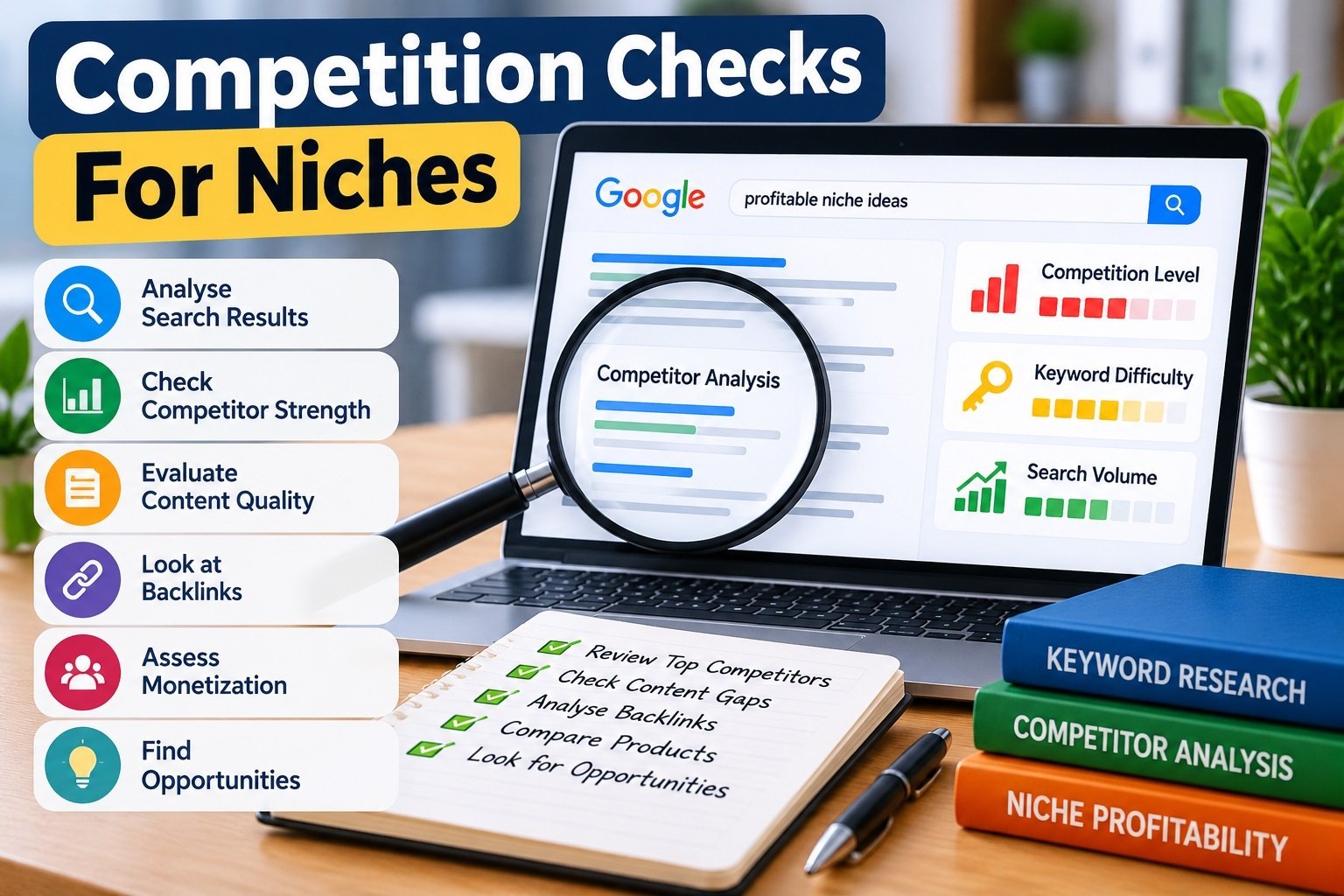
The goal isn’t necessarily to find a niche with zero competitors; it’s to understand the competitive environment, spot where existing content falls short, and determine whether a clearly defined audience is still underserved. This guide explains what to look at, how to interpret what you find, and how to decide whether a niche is winnable or should be skipped.
Why Competition Checks Matter
Competition determines how long it takes to earn your first commission, and whether you earn one at all. A niche with modest demand and weak competitors can outperform a huge niche where you’re permanently stuck on page four. A quick, structured competition check turns a gut feeling into an evidence-based decision, and it also reveals genuine content opportunities: competitors often cover the popular topics well while overlooking smaller questions or specific audience needs that your site could address instead.
What Competition Research Should Cover
- Competing websites and how established they are
- Search engine results for your core keywords
- The specific keywords and search intent competitors target
- The affiliate products and programs competitors promote
- Content quality, depth, and how frequently it’s updated
- Website authority and backlink profiles
- Website structure, navigation, and internal linking
- Potential content gaps and underserved audience segments
What Kinds of Competitors To Look For
Large Brands And Publishers
Major brands, national media outlets, and big review publishers carry enormous authority. If they dominate every result for your core keywords, breaking in will be very difficult for a new site.
Established Niche Sites
Focused affiliate sites with years of content and backlinks are tough but sometimes beatable, especially if their content is outdated or thin in certain areas.
Small Independent Sites
Newer or smaller sites ranking on page one are one of the best signs a niche is accessible. If they can rank, a well-executed site can likely do the same.
Forums And User-Generated Content
Discussion threads and community answers ranking highly often mean search engines can’t find strong, dedicated content. This is frequently a sign of opportunity.
Step-by-Step Niche Competition Check
- Pick 10 to 15 target keywords that represent the core topics and buying searches in the niche.
- Search each one and record who ranks in the top ten results.
- Classify each result as a large brand, established niche site, small independent site, or forum and community content.
- Check the age and depth of the ranking pages, noting whether they are recent, comprehensive, and well-structured.
- Review the backlink profile of leading pages using a backlink analysis tool to see how many links you would need to compete.
- Note content gaps where existing pages are thin, outdated, or fail to answer the searcher’s real question.
- Decide whether a realistic path to page one exists within your time and resources.
What To Analyze On Competitor Websites
Content
Look at how many articles competitors publish, how detailed those articles are, and whether they include product reviews, comparisons, tutorials, and FAQ content. Note how frequently the content appears to be updated.
Keywords And Search Intent
Investigate the types of keywords competitors target, covering informational, commercial, and transactional searches. The same core topic can carry very different intent depending on its modifier:
- Informational: “What is affiliate marketing software?”
- Commercial: “Best affiliate marketing software”
- Comparison: “Tool A vs Tool B”
- Transactional: “Buy affiliate marketing software”
Affiliate Products
Examine the products and services competitors promote to identify affiliate programs relevant to your audience. Never assume a competitor’s affiliate relationship guarantees the same program will accept you or offer the same terms; always check current requirements directly.
Website Structure
Study how competitors organize navigation, categories, review and comparison pages, internal links, calls to action, and disclosure information. The goal is understanding how successful sites structure information, not copying their design.
Key Metrics To Evaluate
- Keyword difficulty scores from a research tool, used as a rough guide rather than an absolute truth
- Domain authority or similar site strength indicators for the top-ranking competitors
- Number of referring domains linking to the top results
- Content length, depth, and freshness compared with what you could realistically produce
- Presence of ads, shopping results, or featured snippets that push organic results lower on the page
- Number of independent, small sites appearing in top results
How To Find Competition Gaps
Look For Unanswered Questions
People frequently ask questions existing articles don’t fully address, such as beginner problems, product-specific questions, cost questions, and questions about alternatives. Each unanswered question is a potential content idea.
Look For Underserved Audiences
A broad niche can often be divided into smaller audiences with specific needs. Instead of targeting everyone interested in technology, for example, a site could focus narrowly on beginners looking for simple business software, making it far easier to create highly relevant, differentiated content.
Green Flags: Signs A Niche Is Winnable
- Small or newer sites appear regularly among the top results
- Top-ranking content is thin, outdated, or poorly organized
- Forums, question sites, or social posts rank for commercial searches
- Long-tail variations have low competition but clear buyer intent
- Few competitors offer original photos, testing, or hands-on experience
Red Flags: Signs A Niche Is Too Competitive
- Every top result belongs to a major brand or high-authority publisher
- Top pages have hundreds of quality backlinks that would be very difficult to match
- Results pages are crowded with ads, shopping carousels, and featured snippets
- Competitors update content frequently and cover every subtopic in depth
- You cannot identify any angle that would make your content meaningfully different
What To Do If Competition Is High
Narrow Your Focus
Target a specific audience, use case, or product category instead of the whole industry. Narrower topics usually face weaker competition and let you build authority faster.
Target Long-Tail Keywords First
Longer, more specific search phrases typically have less competition. Winning several of them builds authority that can help you tackle tougher keywords later.
Differentiate With Original Value
Hands-on testing, original photos, expert input, and unique comparisons give your content qualities competitors may lack, helping it stand out even in crowded spaces.
Consider A Different Niche
Sometimes the smartest move is to walk away. If no realistic angle exists, moving to a more accessible niche is a strategic decision rather than a failure.
A Competition Check Checklist
- Identify your main competitors across large brands, niche specialists, and small independent sites
- Search your most important keywords and record who ranks
- Examine content quality, depth, and update frequency on the pages that rank
- Identify the products and affiliate programs competitors promote
- Look for content gaps and underserved audience segments
- Check keyword opportunities across informational, commercial, and transactional intent
- Confirm relevant affiliate programs actually exist for the niche
- Consider honestly whether you can consistently produce content that’s meaningfully better
Common Mistakes When Checking Niche Competition
- Looking only at search volume, without weighing search intent, competition, and commercial relevance together
- Choosing a niche purely because competition looks low, which can just as easily signal weak demand as genuine opportunity
- Copying competitors instead of using their content as a benchmark for original, genuinely useful material
- Ignoring smaller competitors and analyzing only the biggest sites, missing gaps that smaller niche sites have already found
How Competition Checks Fit Into Niche Selection
Competition research is one part of a broader niche-selection process, not a standalone decision on its own. A complete evaluation weighs competition alongside audience demand, keyword opportunities, available affiliate programs, product availability, search intent, your own knowledge and interest, and long-term content potential. Looking at these factors together gives a far more reliable picture than relying on competition data alone.
Frequently Asked Questions
How much competition is too much for a new affiliate site?
If every top result is a high-authority brand with strong backlink profiles and you cannot find a differentiating angle, competition is likely too high for a new site. Some competition is normal and healthy.
Are keyword difficulty scores reliable?
They are a useful starting point, but each tool calculates scores differently. Always confirm by reviewing the actual search results and the strength of the pages that rank.
Is low competition always good?
Not necessarily. Very little competition can mean there’s little demand or few monetization options, so pair a competition check with product and affiliate program validation.
How long should a competition check take?
A focused review of 10 to 15 keywords typically takes a few hours, and it can prevent months of wasted effort on an unwinnable niche.
Can a new site ever beat established competitors?
Yes, especially by targeting long-tail keywords, offering better or more original content, and focusing on a narrow angle where larger sites haven’t gone deep.
How can I check niche competition without paid tools?
Search engines alone can reveal a lot: examine who ranks for your core keywords, study their content depth and structure, check their product recommendations and FAQs, and note how active they are on social media.
