
Informational Posts That Convert By Turning Top-of-Funnel Content Into Commissions
Not every article on an affiliate site is built to sell directly, and that’s by design. Informational posts that convert solve a reader’s immediate question first, then guide them toward a product, comparison, or review page once their understanding of the topic is solid enough to act on.
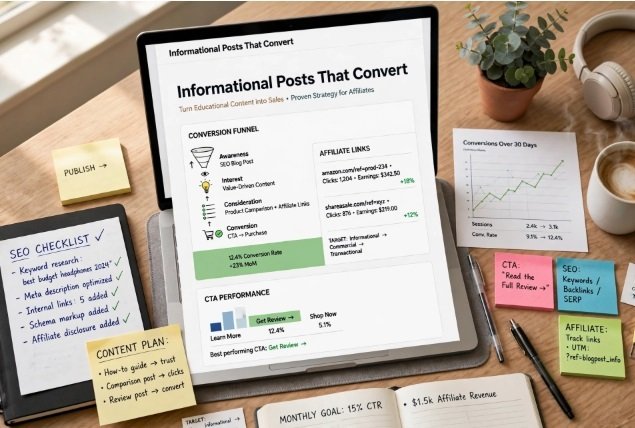
The goal isn’t to turn every paragraph into a sales pitch; it’s to provide enough genuine value that readers trust the site and understand why a recommendation later on is actually relevant to their situation. Done well, this content doesn’t feel like a detour on the way to a sale; it feels like genuine help that happens to end somewhere useful. This guide covers how to choose topics, structure posts, place links, and measure whether this content is actually working.
Informational Content Is Important For An Affiliate Business
Most buyers don’t start their search ready to purchase. They start with a question: how does this work, what’s the difference between these options, what should I know before I buy. Informational posts capture that earlier stage of the journey, building trust and topical authority before the reader has even considered a specific product. Without this layer, a site is left competing purely on bottom-of-funnel keywords, which tend to be the most competitive and expensive to rank for.
Why Does An Informational Post Convert
- It genuinely answers the reader’s question first, without rushing toward a sales pitch
- It builds enough context that a product recommendation later in the piece feels earned, not forced
- It links naturally to commercial pages at the exact point where that connection makes sense
- It establishes credibility through accurate, specific information rather than vague generalities
- It respects the reader’s current stage, neither overselling too early nor under-explaining the basics
Choosing Topics That Lead Somewhere
Not every informational topic has a natural path to a commercial page, and that’s fine for some content. But the informational posts worth prioritizing are the ones where answering the question naturally raises the next question: what should I buy, or which option is right for me. Starting with a specific reader problem, rather than a broad topic chosen because a keyword tool reported volume, makes both the content and the eventual recommendation far easier to get right.
- Look for “what is,” “how does,” and “why” searches within your niche that relate to a product category you cover
- Favor topics where understanding the subject is a genuine prerequisite to choosing a product well
- Map each informational topic to the specific review, comparison, or buying guide it should eventually point to
- Avoid purely abstract topics with no realistic connection to anything you can recommend
Writing For The Reader’s Stage In the Buying Journey
Not every visitor is ready to buy immediately, and matching the content and the recommendation to where the reader actually is makes the difference between a post that converts and one that feels mistimed.
Awareness Stage
At this stage, readers are trying to understand a problem, with searches like “what is affiliate marketing” or “how does email marketing work.” These posts should focus almost entirely on education, with any commercial mention kept light.
Consideration Stage
Here, readers are exploring possible solutions, searching things like “how to choose an email marketing platform.” Affiliate recommendations can become more prominent at this stage, since the reader is actively weighing options.
Decision Stage
Readers at this stage are comparing specific products or looking for confirmation before buying. This is where comparison pages, reviews, and best-of lists connect strongly with the informational content that led them here.
How To Structure An Informational Post For Conversion
Answer the Core Question Immediately
Readers arriving from a search expect their question answered quickly. Burying the answer under unnecessary preamble increases bounce rate and reduces the chance they stick around long enough to reach your recommendation later.
Build Context Gradually
Once the immediate question is answered, use the rest of the post to build the background a reader needs to make a good decision, such as what factors matter, what mistakes beginners make, or how different situations change the right answer. Concrete examples help here, turning abstract advice into something a reader can actually apply to their own situation.
Introduce the Natural Next Step
Near the end, or at a clear transition point, introduce the logical next step: a buying guide, a comparison, or a specific recommendation that follows naturally from what the reader just learned.
Use a Soft, Contextual Call to Action
Avoid an abrupt sales pitch. A line like “if you’re ready to compare options, here’s our breakdown of the top choices” reads as helpful continuation rather than an interruption. Vague prompts without a clear next step tend to underperform; be specific about what the reader can do and why it’s worth doing.
Internal Linking As The Conversion Mechanism
For informational content, internal links do the actual converting, not the article itself. The post’s job is to build enough trust and context that a reader clicks through to a commercial page willingly, rather than closing the tab once their question is answered.
- Link to a specific, relevant review or comparison rather than a generic category page
- Place the link where it naturally continues the reader’s thought, not forced into an unrelated sentence
- Use descriptive anchor text that tells the reader exactly what they’ll find on the other end
- Limit the number of links so the most important one doesn’t get lost among several competing options
Using Contextual Affiliate Links Within the Content
A natural affiliate link works best immediately after explaining a solution the product actually addresses. After explaining why website analytics matters, for example, introducing a specific analytics platform and explaining what it does and who benefits from it reads as a continuation of the lesson, not an unrelated pitch. This is generally far more effective than inserting a link into a paragraph purely to increase link count, and too many links scattered through an informational piece can make the whole article feel less objective.
Common Mistakes With Informational Content
- Writing purely for search volume with no realistic path toward a commercial page
- Rushing to a product mention before the reader’s actual question has been answered
- Promoting a product that doesn’t genuinely match the topic, which damages reader trust
- Treating informational content as filler instead of a genuine part of the conversion funnel
- Leaving out any internal link to commercial content, wasting an engaged reader’s attention
- Ignoring the reader’s buying stage, such as pushing a detailed comparison on someone still at the awareness stage
- Writing generic, shallow answers that don’t actually build the trust needed to convert later
Measuring And Improving Performance Over Time
Informational content rarely converts on the page itself, so judging it purely by direct affiliate clicks misses the point. Instead, track how often readers click through to the commercial pages it links to, and whether traffic from these posts eventually shows up in conversions elsewhere on the site. A post with strong traffic but no click-through to linked commercial pages is usually a sign the internal linking, not the content itself, needs attention.
- Review pages with strong traffic but low click-through to commercial content
- Improve the placement and wording of calls to action that aren’t performing
- Strengthen internal links to the most relevant commercial pages
- Update outdated information and sections that fail to fully answer the reader’s question
- Keep affiliate disclosures easy to find throughout the content
Frequently Asked Questions
Should informational posts contain affiliate links directly?
They can, but their main job is building trust and linking internally to commercial pages where the actual conversion usually happens. A direct affiliate link can still work if it fits naturally at a relevant point in the content.
How do I know if an informational topic is worth writing about?
Check whether answering the question naturally leads to a product decision you can actually help with. If there’s no realistic path to a commercial page, the topic may still be worth covering for authority, but shouldn’t be expected to convert directly.
How long should an informational post be?
Long enough to answer the question thoroughly and build genuine context, but not padded purely to hit a word count. Depth should come from usefulness, not length for its own sake.
Where should the internal link to commercial content go?
At the point where the reader’s understanding naturally raises the next question, often after you’ve explained the key factors that would influence a purchasing decision.
Are informational posts better than product reviews for affiliate marketing?
Neither is automatically better. Informational posts attract readers earlier in the buying journey, while reviews target readers already evaluating a specific product. Using both together builds a stronger overall content strategy than relying on just one.
Can informational content rank well against bigger sites?
Often, yes, since broad informational keywords are sometimes less commercially contested than product-focused ones, though this varies by niche and should be checked with a proper competition analysis.
