
Micro Niche Versus Broad Niche: The Complete Guide to Choosing Your Structure
Before writing a single piece of content, every affiliate marketer faces the same structural decision: build a site tightly focused on one narrow subject, or cover a wider category with room to expand in many directions. This is the micro niche versus broad niche question, and it shapes everything that follows, from your target audience and content calendar to the affiliate programs you’ll realistically be able to promote.
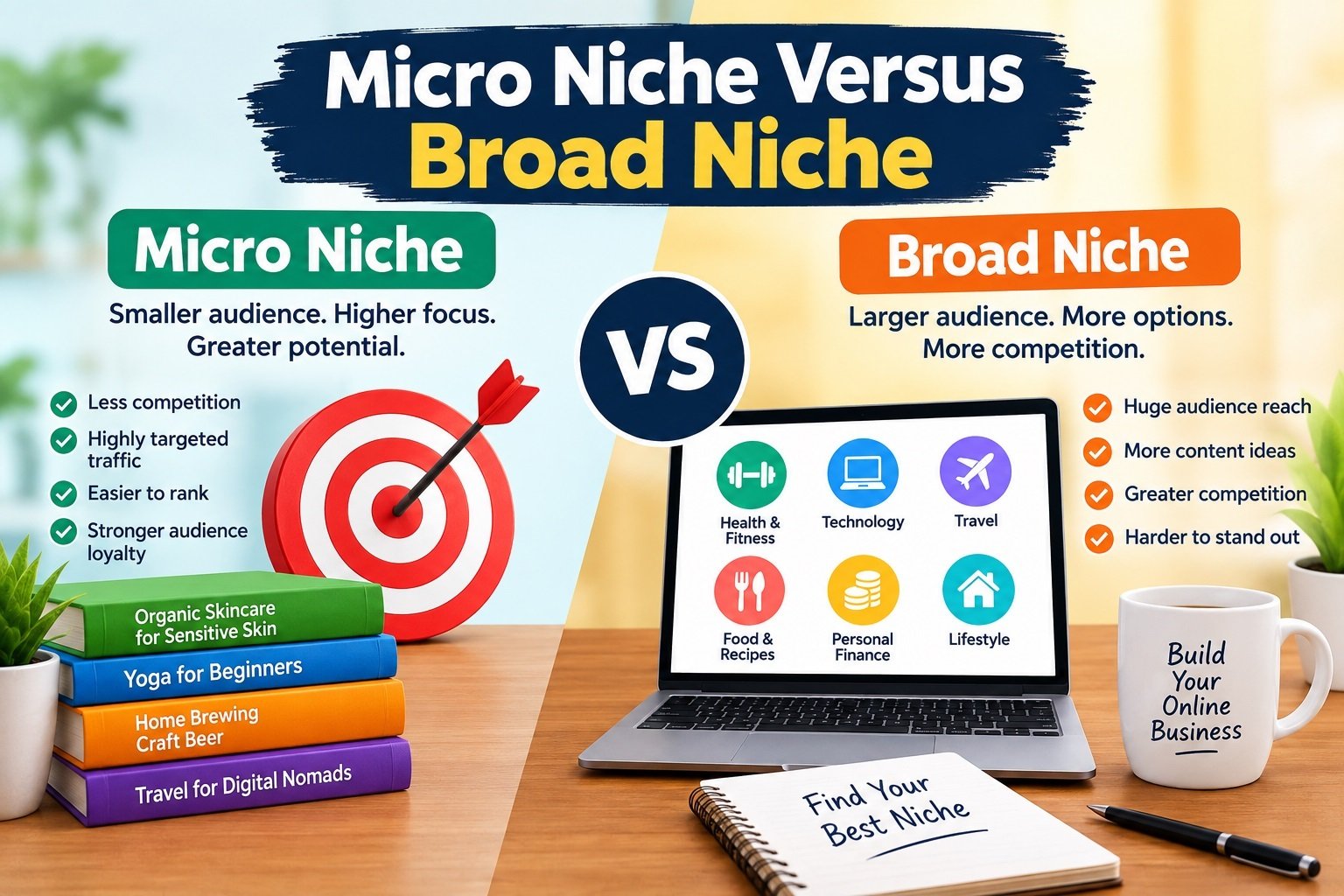
Neither structure is universally correct. Each comes with different tradeoffs around audience size, competition, ranking speed, and long-term income potential. This guide brings all of those factors together so you can choose the structure that actually fits your goals and resources.
What Is A Broad Niche?
A broad niche is a large market category containing many smaller topics and subtopics, such as personal finance, home fitness, technology, or outdoor recreation. Broad niches appeal to a large potential audience and provide room to branch into dozens of related subjects over time. Within personal finance alone, an affiliate site could cover budgeting, investing, credit cards, insurance, banking, and side income, all under one roof.
What Is A Micro Niche?
A micro niche narrows in on one specific product category, problem, or audience segment rather than an entire topic area. Instead of targeting fitness broadly, a micro niche site might focus on home workouts for beginners, or narrow further into resistance-band workouts for beginners at home. The scope is intentionally tight, often built around a limited set of closely related keywords and a clearly defined reader.
Examples of Broad Niches
- Health and fitness
- Personal finance
- Technology
- Travel
- Home improvement
- Beauty
Examples of Micro Niches
- Resistance-band workouts for beginners
- Budget travel for solo travellers
- Home office equipment for remote workers
- Web hosting for small businesses
- Personal finance for university students
- Productivity software for freelancers
How A Broad Niche Can Be Narrowed Into A Micro Niche
Most micro niches are simply a broad niche narrowed down through several layers of specificity. Seeing the progression side by side makes the relationship between the two structures much clearer.
- Technology → Computers → Laptops → Laptops for students
- Fitness → Home workouts → Strength training → Resistance-band training
- Finance → Personal finance → Budgeting → Budgeting for students
- Travel → Budget travel → Solo travel → Budget solo travel
Comparing Micro Niche And Broad Niche Across Key Factors
Audience Size
A broad niche normally has a larger potential audience because the subject covers many related interests. A micro niche has a smaller potential audience because the subject is more specific. Audience size alone isn’t the deciding factor, though; a smaller audience can still be highly valuable when its members have a clear, strong interest in the products being promoted.
Competition And Ranking Speed
Broad niches often contain many established websites, publishers, and brands, which can make it difficult for a new site to compete for the most valuable search terms. Because a micro niche site covers a narrow set of highly specific keywords, it can often demonstrate topical relevance to search engines faster, translating into quicker initial rankings for long-tail, lower-competition terms. Competition still exists within micro niches, so they should never be assumed to be competition-free.
Content Opportunities
Broad niches can provide an extremely large number of potential content topics. A technology site, for example, could publish articles about computers, smartphones, software, accessories, artificial intelligence, and cybersecurity. A micro niche has fewer overall subjects, but that narrower focus makes it easier to build a highly specialized, deeply connected content library.
Affiliate Product Selection
A broad niche typically provides access to a larger selection of affiliate products and programs across many subtopics. A micro niche generally has a smaller selection, but the products available can be closely aligned with the audience’s specific interests, which often supports stronger relevance and trust with readers.
Long-Term Income Potential
Micro niches often hit a traffic ceiling once the available keyword opportunities within that narrow topic are exhausted, though they can still generate solid income within that ceiling, particularly in categories with high-value products. Broad niches offer significantly more room to grow, since new subtopics and content angles can be added indefinitely, and they typically diversify monetization across more affiliate programs, reducing dependency on any single offer.
Advantages And Challenges of A Broad Niche
Advantages
- Large potential audience: A broad subject can attract visitors with many different interests.
- Many content ideas: There are usually numerous subtopics to explore for years.
- Wide product selection: Broad markets typically contain many affiliate opportunities.
- Room for expansion: A site can move into related subtopics as it grows.
- Diversified revenue: Different subtopics can support different affiliate programs, spreading risk.
Challenges
- High competition: Popular markets often contain many established, high-authority websites.
- Large content requirements: Covering a broad subject comprehensively demands significant time and resources.
- Audience diversity: Visitors may have very different needs, making messaging harder to focus.
- Slower brand positioning: It can take longer to establish a clear identity when covering a large market.
- Difficult keyword competition: Many broad, high-volume keywords are hard for a new site to rank for.
Advantages And Challenges of A Micro Niche
Advantages
- Focused audience: Content can be created for a clearly defined group of people.
- Specific content: Articles can address particular questions and problems in depth.
- Clear positioning: Visitors can quickly understand what the site is about.
- Relevant affiliate products: Products can be matched closely to the audience’s specific needs.
- Faster specialization: Consistently publishing on one subject helps establish topical depth sooner.
Challenges
- Smaller audience: The number of potential visitors may be limited by design.
- Limited content runway: There may be fewer useful topics available than in a broad niche.
- Fewer affiliate programs: Some micro niches have a limited number of suitable programs.
- Concentrated risk: A single algorithm update or shift in demand can significantly impact the entire site.
- Over-specialization: Narrowing too far can make it difficult to expand the site later.
How To Choose Between A Micro Niche And A Broad Niche
Consider Your Target Audience
Start by identifying the people you want to serve, along with their problems, goals, and purchasing needs. A clearly defined audience makes it easier to develop relevant content and select appropriate affiliate products, regardless of which structure you choose.
Research Search Demand
Research the keywords and questions people use when searching for information about the subject. Look for consistent evidence of interest rather than relying on search volume alone, and consider whether that audience is likely to be interested in the products tied to your affiliate business.
Research the Competition Honestly
Examine the websites already ranking in the space. Look at the content they publish, the questions they answer well, the products they promote, and where gaps remain that a new, focused site could fill.
Check Affiliate Opportunities Before Committing
- Identify companies that serve your target audience
- Check whether they run affiliate programs
- Review their commission structures and typical payouts
- Check cookie durations and attribution rules
- Review payment terms, thresholds, and payout methods
Think About Long-Term Content Depth
A successful affiliate site generally needs more than a handful of articles. Consider whether the niche, broad or micro, provides enough questions, comparisons, guides, and subtopics to sustain a growing content library for years, not just months.
Can You Combine Both Approaches?
Yes, and many successful affiliates do exactly this. A common strategy involves starting with a micro niche to validate demand and build initial rankings quickly, then gradually expanding into adjacent subtopics until the site effectively becomes a broader authority within that original category. This captures the faster early traction of a micro niche while still working toward the larger long-term ceiling of a broad niche. The reverse is also possible: a broad niche can be approached by first building deep authority in one narrow sub-niche before expanding outward.
Common Mistakes When Choosing Between The Two
- Choosing a topic only because it’s popular, without checking whether a new site can realistically compete
- Making a micro niche too narrow, leaving insufficient audience demand, content potential, or product availability
- Ignoring affiliate program availability before committing significant content effort to either structure
- Neglecting the audience in favor of chasing keywords or commission rates alone
- Switching structures too often, which prevents either approach from building real authority
Frequently Asked Questions
What is the main difference between a micro niche and a broad niche?
A broad niche covers a large market category with many related subjects, while a micro niche focuses on a much smaller, clearly defined segment within that market, such as one product type or one specific audience.
Is a micro niche always easier to rank for than a broad niche?
Generally, yes, in the early stages, since a narrow focus makes it easier to demonstrate topical relevance quickly. That advantage tends to diminish over time as more competitors target the same limited set of keywords.
Can a micro niche site eventually become a broad niche site?
Yes. Many successful sites start narrow and gradually expand into related subtopics as they build authority, effectively transitioning into a broader niche over time.
Which structure is better for beginners?
Micro niches are often more manageable for beginners due to their smaller content requirements and faster feedback loop, making it easier to test whether a niche has real potential before committing significant resources.
Do broad niches always earn more than micro niches?
Not necessarily in the short term, since broad niches take longer to build authority. Over a longer time horizon, broad niches generally offer a higher overall income ceiling due to their larger content and traffic potential.
How do I know if my micro niche has hit its ceiling?
Signs include plateauing traffic despite continued content publishing, a shrinking list of new relevant keyword opportunities, and diminishing returns from further content additions within that narrow topic.
How narrow should a micro niche be?
Specific enough to clearly identify a single target audience and their core problem, while still leaving enough demand, content ideas, and affiliate products to sustain the site long-term.
