
Niche Validation With Real Products: The Complete Guide To Testing Demand
Keyword tools can tell you that people search for a topic, but they can’t tell you whether those people actually spend money on it. That gap is where many affiliate sites fail: plenty of traffic, almost no purchases. Niche validation with real products closes that gap by looking at what is actually being sold, reviewed, returned, and repurchased in a market before you commit months of effort to it.
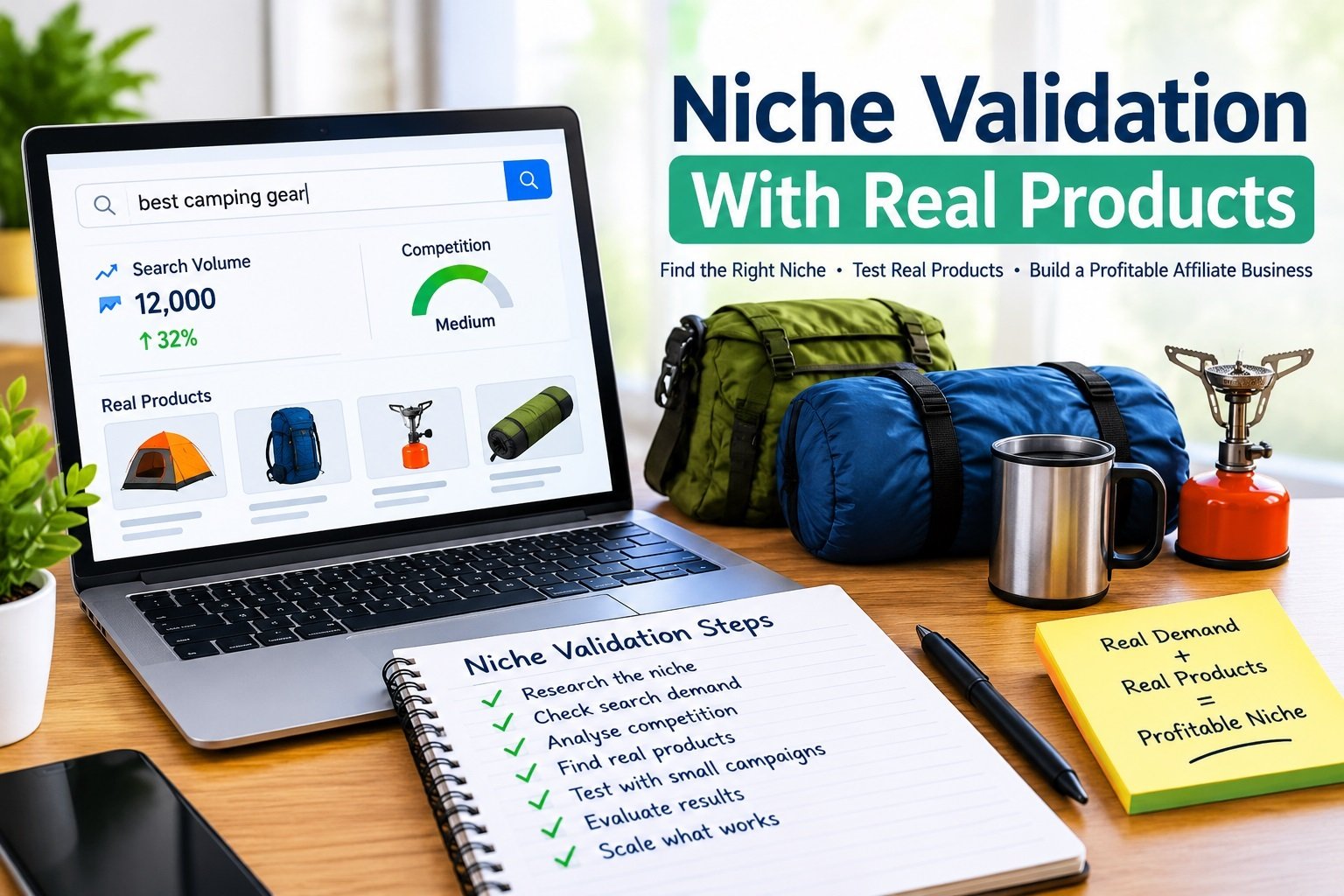
Instead of asking only whether a niche sounds interesting, this approach examines the actual products, customers, prices, affiliate programs, and competition within the market. This guide brings the full process together, from the signals worth checking to a validation checklist you can run before building anything.
What Is Niche Validation With Real Products?
Niche validation with real products is the process of researching actual products and services within a potential niche to determine whether there is sufficient demand and commercial opportunity. For an affiliate marketer, this means looking beyond the name of a niche and examining the specific products customers can purchase. Instead of simply choosing the broad category of “fitness,” you would investigate specific products such as home workout equipment, fitness trackers, resistance bands, and exercise software, and check whether people are actively searching for, comparing, reviewing, and buying them.
Why Product-Based Validation Beats Keyword Data Alone
Search volume measures curiosity, not buying behavior. Someone researching “how do solar panels work” and someone searching “best 400W solar panel for RV” are both counted in a topic’s traffic, but only the second is close to a purchase. Real products give you evidence of transactions, price points, and customer satisfaction that no keyword report can show on its own. A niche can appear interesting on paper without being commercially viable, and examining real products is what confirms whether businesses are actually serving paying customers in that market.
What Examining Real Products Reveals
- Products that customers are already purchasing
- Different price points and commission tiers within the niche
- Potential affiliate programs tied to specific brands
- Popular product categories and adjacent subtopics
- Recurring-purchase or subscription opportunities
- Products suitable for comparison articles and buying guides
- Content gaps left by existing reviews and guides
Where To Find Real Product Signals
Marketplace Listings And Best-Seller Lists
Large online marketplaces publish ranking lists showing which products in a category sell consistently. A category with many established, well-reviewed products usually indicates proven demand, while a category with only a few obscure listings may signal a market too small to support a content site.
Customer Reviews
Reviews reveal what buyers love, what frustrates them, and which questions they ask before purchasing. Recurring complaints and unanswered questions are content opportunities, since your articles can address the exact concerns shoppers already have, such as which product suits beginners, how two models differ, or what features actually matter.
Affiliate Network Product Feeds
Browsing merchant listings inside affiliate networks shows which brands are actively investing in affiliate partnerships within a niche. A cluster of active merchants across different price tiers is a strong sign the market is commercially healthy.
Competitor Affiliate Sites
Studying which specific products competing sites recommend, and how prominently, shows where affiliates are already finding conversions. Products that appear repeatedly across many sites are usually converting well. Competition here isn’t automatically a reason to walk away; it can confirm commercial activity while also revealing gaps a new site could fill.
A Step-by-Step Product Validation Process
- List 10 to 20 real products that sit inside your potential niche, covering budget, mid-range, and premium options across multiple related categories, not just one product type.
- Record the price range for each tier, including any subscriptions or recurring services, to confirm the average commission per sale would be worth the effort.
- Check review counts and ratings to see whether buyers are actively purchasing and engaging with these products.
- Confirm affiliate programs exist for the main brands, noting commission rates, cookie durations, payment terms, and any geographic restrictions.
- Search for buyer-intent queries such as “best [product],” “[product] vs [product],” and “[product] for beginners” to confirm people are actively researching before buying.
- Study competing content to see what formats already rank well and where the coverage is thin, outdated, or fails to answer real buyer questions.
- Estimate potential earnings by combining realistic traffic assumptions with average price and commission figures.
Look Beyond The Product To The Problem It Solves
Successful affiliate content is usually connected to a problem the reader wants solved, not just a product they want to buy. Someone searching for a specific piece of equipment may really be trying to save time, reduce discomfort, improve productivity, or achieve a particular result. Identifying that underlying need, alongside the product itself, helps you create content that’s genuinely useful before a recommendation is ever introduced.
Check Product Quality And Reputation Before You Promote
Your site’s credibility is tied to what you recommend, so validation should include the product itself, not only its commission rate. Before committing to a niche, review each product’s specifications, customer feedback, warranty terms, return policy, and the seller’s general reputation. A niche full of products with high return rates or frequent quality complaints will produce clawed-back commissions and damaged trust, regardless of how attractive the headline payout looks.
Signs A Niche Passes Product Validation
- Multiple products across different price tiers with steady, recent review activity
- Several reputable brands running affiliate programs with reasonable payouts
- Recurring buyer questions that aren’t well answered by current top-ranking content
- Repeat-purchase, subscription, or accessory opportunities that extend the value of each customer
- Consistent demand across the year rather than a short seasonal burst
- Enough related product categories to support dozens of articles without running out of angles
Red Flags That Suggest Weak Demand
- Very few products available, or mostly unrated listings with no purchase history
- Extremely low price points that make commissions too small to matter
- High return rates or widespread quality complaints that lead to refunded commissions
- No active affiliate programs among the main sellers in the category
- Products that depend on a single brand, leaving your income exposed to one program’s rule changes
Hands-On Validation: Testing Before You Commit
Buy or Try a Few Products Yourself
Using products firsthand gives you original insights and photos, which strengthens the trust and originality signals that search engines and readers both reward. It also shows you whether products actually live up to their marketing.
Publish A Small Test Batch of Content
Before building out a whole site, publish a handful of product-focused articles and monitor clicks, impressions, and any early conversions. Real reader behavior is the final and most reliable validation signal, and it’s far cheaper to gather early than after months of full-scale publishing.
Ask the Audience Directly
Short surveys, social media polls, or community threads can reveal which products people are already considering, and which problems they still need solved.
A Simple Niche Validation Checklist
- Are there real, purchasable products in the niche, across more than one category?
- Are people actively searching for and comparing these products?
- Are customers leaving reviews and discussing them online?
- Do reliable affiliate programs exist, with reasonable commission and payment terms?
- Are the products relevant and available to your intended audience?
- Can you create genuinely useful content, not just promotional listings, around these products?
- Is there a realistic way to differentiate your content from existing competitors?
- Does the niche contain enough depth to support long-term content growth?
Common Mistakes When Validating a Niche
- Choosing a niche because it looks popular, without checking whether real, sellable products and programs actually exist within it
- Focusing only on commission rates, even when the underlying product has weak demand or a poor reputation
- Ignoring product availability in your target audience’s region or market
- Promoting products without firsthand research, which risks recommending items that don’t hold up to scrutiny
- Trying to cover every possible product instead of focusing on a clearly defined audience and their specific needs
How Product Validation Shapes Your Content Strategy
Once a niche passes validation, the same product research becomes the foundation of your content plan. A single validated product category can support an introductory guide, a detailed review, a head-to-head comparison, a buying guide, a common-mistakes article, an alternatives roundup, and a frequently asked questions page, covering readers at every stage of the buying journey rather than just the search itself.
Niche Validation Is An Ongoing Process
Validation isn’t a one-time task you complete before launch and never revisit. Markets shift, products get discontinued, companies change their affiliate terms, and customer preferences evolve. Periodically review the products and programs behind your content, replacing anything that’s outdated, unavailable, or no longer relevant, so your recommendations stay accurate and your affiliate links keep converting.
Frequently Asked Questions
How many products should I review before deciding on a niche?
Looking at 10 to 20 real products across different price levels and categories usually gives enough data to judge demand, price range, and affiliate program availability without overanalyzing. There’s no universal number; the goal is enough evidence to support a confident decision.
Do I need to own the products to validate a niche?
No. Marketplace data, reviews, and affiliate feeds provide plenty of validation signals on their own. Owning or testing a few products becomes valuable later, once you’re creating content designed to stand out from competitors.
Can a niche have traffic but still fail product validation?
Yes. A niche can attract plenty of informational searches while offering few products worth buying, or products with commissions too small to justify the content investment. Traffic alone was never proof of commercial viability.
Should I choose a niche purely for its high commission rates?
No. Commission rate is only one factor and should be weighed alongside product demand, quality, audience relevance, competition, and affiliate program terms. A high commission on a product nobody buys or trusts isn’t worth pursuing.
Can a competitive niche still be viable?
Yes. Competition often confirms that a market has genuine commercial activity. The more useful question is whether existing content has gaps you can fill with more specific, original, or up-to-date coverage.
How long should the validation process take?
A focused research pass typically takes several days to a couple of weeks, followed by a small content test lasting a few months to gather real traffic and conversion signals before committing further.
